

Outdoor Fireplace Design: Redefining Fire Through Architecture
Sep 19, 2026
The traditional outdoor fireplace has always been a destination—a permanent place to gather around fire. But modern outdoor architecture has created new possibilities.
Fire no longer has to be contained within a large masonry structure or confined to one location. It can rise vertically, mount to a wall, frame an entrance or stand beside a pool as a sculptural element of the landscape.
At HaloFire, we believe the flame itself should be the focal point.
This guide explores how architectural fire features can complement or provide an alternative to the traditional outdoor fireplace, including vertical vortex fire, natural gas and propane systems, portable liquid-fuel torches and custom fire installations.
Key Takeaways
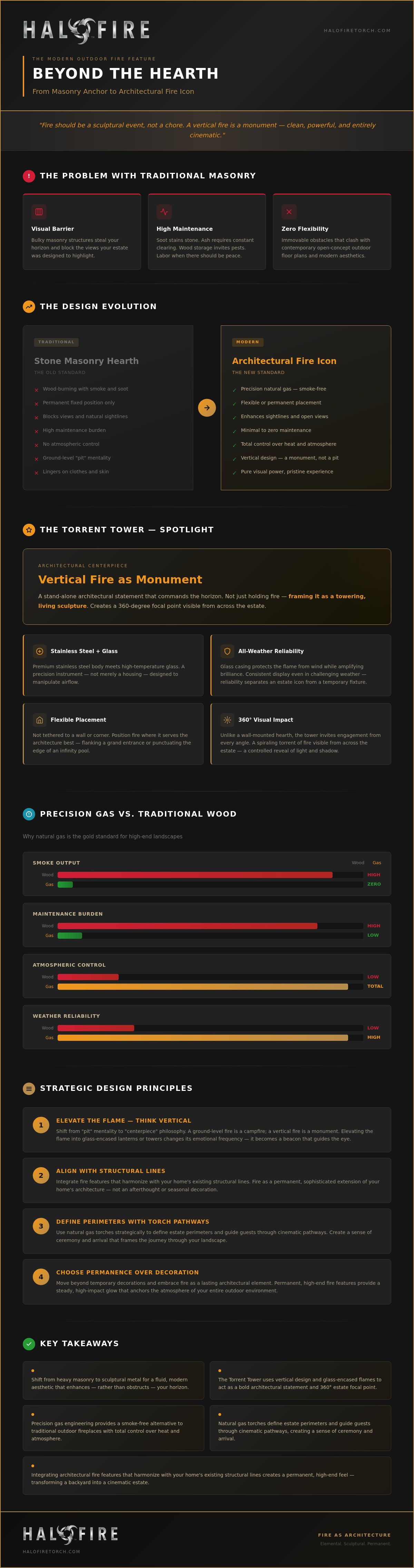
- An outdoor fireplace is no longer the only way to make fire an architectural focal point.
- Vertical fire can preserve sightlines while increasing the visibility of the flame.
- Natural gas and propane eliminate the smoke, ash and wood storage associated with traditional wood-burning fireplaces.
- Vortex fire features use controlled airflow to create a distinctive spinning vertical flame.
- Architectural gas torches can frame entrances, pools, walls and other landscape features.
- Portable liquid-fuel fire provides another option when permanent gas infrastructure isn't practical.
- The best fire feature should complement the architecture around it rather than simply occupy available space.
Beyond the Hearth: The Evolution of the Outdoor Fireplace
Fire is magnetic.
For centuries, the hearth provided warmth, light and a natural gathering point. Outdoors, that tradition eventually evolved into masonry fireplaces and fire pits built into patios and landscapes.
Those forms still work.
But they aren't the only way to design with fire.
Contemporary architecture often emphasizes open sightlines, large expanses of glass, indoor-outdoor living and unobstructed views. In those environments, a substantial masonry fireplace can sometimes compete with the architecture rather than complement it.
Architectural fire features offer another approach.
Instead of designing a structure around a firebox, you can design around the flame itself.
When Traditional Masonry Works
A traditional outdoor fireplace can be a beautiful architectural element.
Stone and masonry provide visual weight, create a natural gathering area and can complement traditional, Mediterranean, mountain and transitional architecture particularly well.
There are also situations where its substantial structure is exactly what the landscape needs.
The question isn't whether masonry is outdated.
It's whether a large permanent structure is right for the particular space.
If preserving a waterfront view, maintaining an open floor plan or creating a more contemporary environment is important, vertical or freestanding fire may provide an alternative.
From Fireplace to Fire Sculpture
Changing the orientation of the flame changes the experience.
A conventional outdoor fireplace presents fire horizontally within an opening.
A vertical fire feature brings the flame upward.
That simple shift can dramatically increase visibility.
Instead of looking into a firebox, you can see the flame across a pool, through a wall of glass or from the opposite side of a terrace.
The structure can also occupy considerably less visual space than a traditional masonry chimney.
Fire remains the focal point.
The architecture around it becomes lighter.
The Torrent Tower™: A Different Approach to Outdoor Fire
The Torrent Tower™ demonstrates what happens when fire moves vertically.
Rather than enclosing the flame within a conventional fireplace opening, the Torrent Tower frames a vertical vortex flame within glass.
The result is a freestanding architectural object that remains visually open while creating a substantial fire presence.
At approximately 78 inches tall, the Torrent Tower™ Stand Alone places the flame closer to eye level and allows it to remain visible across a large outdoor environment.
It's fire presented as sculpture.
Engineering the Vortex
The spinning flame isn't simply a visual effect added to the product.
Airflow is part of the design.
The relationship between the burner, air inlets and surrounding enclosure encourages rotational movement as the heated gases rise.
That creates the characteristic vertical vortex.
The glass serves several purposes. It provides visibility from multiple directions while helping define the airflow environment around the flame.
Instead of merely containing the fire, the structure participates in creating it.
Preserving the View
One of the advantages of vertical fire is its relatively small footprint.
A traditional outdoor fireplace can require a substantial wall, chimney and foundation.
A vertical fire feature can provide significant visual impact while preserving more of the surrounding sightline.
That makes vertical fire particularly interesting around waterfront properties, pools and modern homes with expansive views.
The objective isn't to replace every outdoor fireplace.
It's to ask a different question:
What if the fire could enhance the view instead of becoming the view?
Gas Fire vs. Wood-Burning Fireplaces
Wood fire has qualities gas cannot completely duplicate.
The crackle, aroma and ritual of building a wood fire are part of its appeal.
It also requires wood storage, produces ash and generates smoke and embers.
Natural gas and propane create a different experience.
Ignition can be nearly instantaneous. There are no logs to store and no ash to remove after the evening is over.
For permanent architectural fire installations, that convenience can be significant.
The Advantage of Control
Gas fire provides predictable fuel delivery.
Depending on the particular system, flame output may be adjustable and electronic ignition can make operation as simple as activating the controls.
Gas also allows designers to create burner geometries that would be difficult to achieve with wood.
Linear flames, rings, vertical flames and vortex effects become possible because the fuel can be delivered exactly where the design requires it.
That makes gas particularly useful when the appearance of the flame itself is part of the architecture.
Natural Gas vs. Propane
Both natural gas and propane can produce substantial architectural fire.
Natural gas is particularly useful for permanent installations where a dedicated gas line can be incorporated into the property.
Propane provides another option when natural gas isn't available and can also power self-contained freestanding products.
Propane contains more energy per unit volume and is commonly delivered to appliances at a different regulated pressure than natural gas, but that doesn't inherently make one fuel visually superior.
Burner design, orifice sizing, available pressure and gas volume all influence actual flame performance.
The system needs to be engineered for the fuel being used.
Permanent vs. Portable Architectural Fire
Not every fire feature needs to be permanently connected to a gas line.
HaloFire offers both permanent and portable approaches to architectural fire.
That distinction gives designers more flexibility when determining how fire should interact with a property.
Permanent Gas Fire
Permanent natural gas and propane installations work particularly well when the fire feature is being incorporated during construction or renovation.
Gas lines can be routed before hardscape is completed, allowing the final installation to remain visually clean.
Wall-mounted torches, tall landscape torches and custom architectural fire features can then become permanent parts of the property.
Freestanding Propane Fire
A product such as the Torrent Tower™ Stand Alone offers a middle ground.
It has the scale and presence of an architectural installation but doesn't require a permanent natural gas line.
The standard configuration operates from a concealed 20 lb propane cylinder and produces approximately 40,000 BTU/hr.
That allows it to be positioned beside a pool, on a terrace or near an entrance without trenching gas infrastructure to the location.
Portable Liquid-Fuel Fire
For even greater flexibility, HaloFire liquid-fuel torches provide real flame without natural gas or propane.
Products such as Helion™ use an integrated reservoir and wick system with compatible HaloFire liquid fuel.
Helion's all-metal, glass-free design creates a vortex flame through controlled airflow while remaining compact enough to reposition around an outdoor environment.
No gas line.
No propane cylinder.
No glass.
It's a completely different scale of fire, but the philosophy remains the same.
Make the flame the focal point.
Designing Fire Into the Landscape
The location of a fire feature determines how it interacts with the architecture.
Rather than treating fire as something to place after the landscape is finished, consider it during the design process.
Think about the primary sightlines.
Where do you first see the property?
What is visible through the windows from inside the home?
Where do people naturally gather?
Where does the architecture need vertical emphasis?
Those questions can determine where fire will have the greatest impact.
Fire and Water
Fire becomes particularly dramatic around water.
A flame positioned beside a pool is reflected across the surface, extending its visual presence beyond the physical dimensions of the feature itself.
Vertical fire can be especially effective because the flame remains visible above furniture, landscaping and the edge of the pool.
A pair of fire features can establish symmetry.
A larger freestanding feature can create a single focal point.
Multiple torches can establish rhythm along the perimeter.
Framing an Entrance
Fire naturally creates a sense of arrival.
Pairs of architectural gas torches can frame gates, entrances, stairways and other transition points.
The effect works because fire is both light and movement.
During the day, the fixtures become part of the architecture.
After dark, the flame changes their character entirely.
Wall-Mounted Fire
Walls offer another opportunity.
Instead of constructing an entire outdoor fireplace, a wall-mounted fire feature can introduce real flame directly onto an existing architectural surface.
The Torrent™ Wall Mounted Torch uses this approach, combining a vertical vortex flame with a permanent architectural mounting system.
Multiple wall-mounted torches can create repetition across a long façade or masonry wall.
This can be particularly effective in restaurants, resorts and other hospitality environments where atmosphere is part of the guest experience.
Custom Architectural Fire
Sometimes the architecture calls for something that doesn't exist in a catalog.
HaloFire works with homeowners, designers, architects and builders on custom fire features for projects that require different dimensions, configurations or flame presentations.
Custom fire design requires more than appearance.
Fuel supply, burner configuration, ignition, airflow, heat management, clearances and service access all need to be considered.
The earlier those requirements are incorporated into the project, the more naturally the fire can become part of the architecture.
The objective isn't simply to build something unusual.
It's to create something that belongs there.
The HaloFire Approach
HaloFire began with a fascination with the flame itself.
That has led us beyond conventional fire pits and fireplaces into vortex torches, vertical fire features, wall-mounted installations, portable glass-free designs and large-scale custom projects.
Some products use natural gas.
Some use propane.
Others use HaloFire liquid fuel.
Some are permanently installed.
Others can move.
What connects them is the idea that the fixture should serve the fire—not the other way around.
Torrent Tower™ Stand Alone
The Torrent Tower™ Stand Alone creates architectural-scale vortex fire without requiring permanent natural gas infrastructure.
At approximately 78 inches tall, its vertical format provides visibility across large outdoor environments while occupying considerably less visual space than a traditional masonry fireplace.
A concealed standard propane cylinder supplies the approximately 40,000 BTU/hr burner.
It's particularly well suited to pools, terraces, entrances and hospitality environments where a large vertical flame can become a focal point.
Torrent™ Wall Mounted Torch
The Torrent™ Wall Mounted Torch integrates vortex fire directly into the architecture.
Available in multiple glass heights, it provides designers with a way to introduce vertical flame onto walls, columns and other suitable architectural surfaces.
Electronic ignition is included, making it particularly appropriate for permanent residential and commercial installations.
Tall Gas Torches
Tall architectural torches provide another way to introduce vertical fire throughout a landscape.
Rather than concentrating the entire fire experience in one location, multiple torches can establish repetition and visual rhythm across a property.
Products such as the Tempo™ Tall Torch and Hollywood™ Tall Torch are designed for this type of application.
They can frame entrances, define outdoor rooms or establish a series of flames throughout a landscape.
Helion™ Glass-Free Vortex Torch
Helion™ takes the vortex concept in the opposite direction.
Instead of increasing scale, it strips the design down.
The all-metal architecture eliminates the glass enclosure while maintaining a visible spinning flame through an open side of the structure.
Because Helion uses compatible HaloFire liquid fuel rather than propane or natural gas, it can be repositioned without gas infrastructure.
It's vortex fire reduced to its essentials.
Choosing the Right Outdoor Fire Feature
Start with the architecture.
If you want a traditional gathering place and the visual mass of masonry complements the home, an outdoor fireplace may be exactly right.
If preserving sightlines is important, consider vertical fire.
If you're building or renovating and gas infrastructure can be incorporated into the project, permanent architectural torches provide a clean solution.
If you want substantial fire without trenching a gas line, a freestanding propane feature may make more sense.
If maximum portability matters, liquid-fuel fire offers another option.
There isn't one correct answer.
The fire should serve the space.
Frequently Asked Questions
What is the difference between a traditional outdoor fireplace and a fire tower?
A traditional outdoor fireplace generally presents fire horizontally within a masonry or fabricated structure and is typically viewed primarily from the front.
A fire tower presents the flame vertically and can provide visibility from multiple directions.
The Torrent Tower™ uses this vertical approach to create a vortex flame within a relatively narrow architectural footprint.
The two designs create fundamentally different experiences rather than one simply being a replacement for the other.
Can the Torrent Tower™ Stand Alone use natural gas?
The standard Torrent Tower™ Stand Alone is designed around a concealed propane cylinder.
HaloFire also produces permanent natural gas fire products and architectural installations.
Fuel configuration is product-specific, so the intended fuel and installation requirements should be confirmed for the exact model before the project is designed.
Do modern gas fire features require much maintenance?
Gas fire features eliminate many of the maintenance requirements associated with wood fire, including ash removal and wood storage.
They still require periodic maintenance.
Burner openings and airflow passages should remain clear of debris. Glass and exterior surfaces should be cleaned as needed, and gas and ignition components should be inspected according to the product's maintenance instructions.
Outdoor and coastal environments may require more frequent cleaning.
Can a gas fire feature be used on a wooden or composite deck?
That depends entirely on the specific product, required clearances, surface construction and manufacturer's installation requirements.
Gas fire does not produce the flying embers associated with wood, but the flame and surrounding components can still generate substantial heat.
Never assume a product is suitable for a combustible surface simply because it is gas-powered.
Follow the instructions for the specific product and applicable local requirements.
How does Helion™ compare with a permanent fire installation?
Helion serves a completely different purpose.
It's a compact liquid-fuel vortex torch designed for portability. It doesn't require a gas line or propane cylinder.
Permanent gas features can provide greater scale and can become integrated directly into the architecture.
Helion provides flexibility.
Permanent fire provides integration.
Which is appropriate depends on what you're trying to accomplish.
Can HaloFire create a custom fire feature for my project?
Yes. HaloFire works with designers, architects, builders and property owners on custom architectural fire projects.
Custom projects can involve different dimensions, mounting configurations, flame presentations and integration requirements.
Because fuel supply, ignition, airflow and clearances influence the design, involving HaloFire early in the project is recommended.
What fuel should I use for outdoor fire torches?
Use only the fuel specified for the particular product.
HaloFire permanent gas torches are designed for their specified natural gas or propane configuration.
HaloFire liquid-fuel products use compatible fuels such as ClearFire™ and CitroFlame™.
ClearFire™ is designed for a clean-burning flame, while CitroFlame™ incorporates citronella and produces a larger visible flame in compatible products.
Never introduce liquid fuel into a natural gas or propane fire feature.
Does HaloFire install gas lines?
HaloFire does not provide local gas-line installation.
Permanent gas piping and final connections should be performed by an appropriately qualified professional in accordance with local requirements and the specifications for the particular HaloFire product.
For larger installations, gas capacity should be considered early so the supply system can support the combined demand of all fire features.
Rethink the Outdoor Fireplace
There is nothing wrong with the traditional outdoor fireplace.
But it is no longer the only way to make fire part of the architecture.
Fire can rise vertically.
It can mount to a wall.
It can frame an entrance.
It can reflect across a pool.
It can move when you want it to move.
Or it can be designed specifically for a project that has never existed before.
The question isn't simply:
Where should we put the fireplace?
It's:
What could we do with the fire?
HaloFire — Where fire is art.

