

Custom Outdoor Fire Features: Architectural Design Trends for 2026
Sep 21, 2026
Fire is becoming part of the architecture.
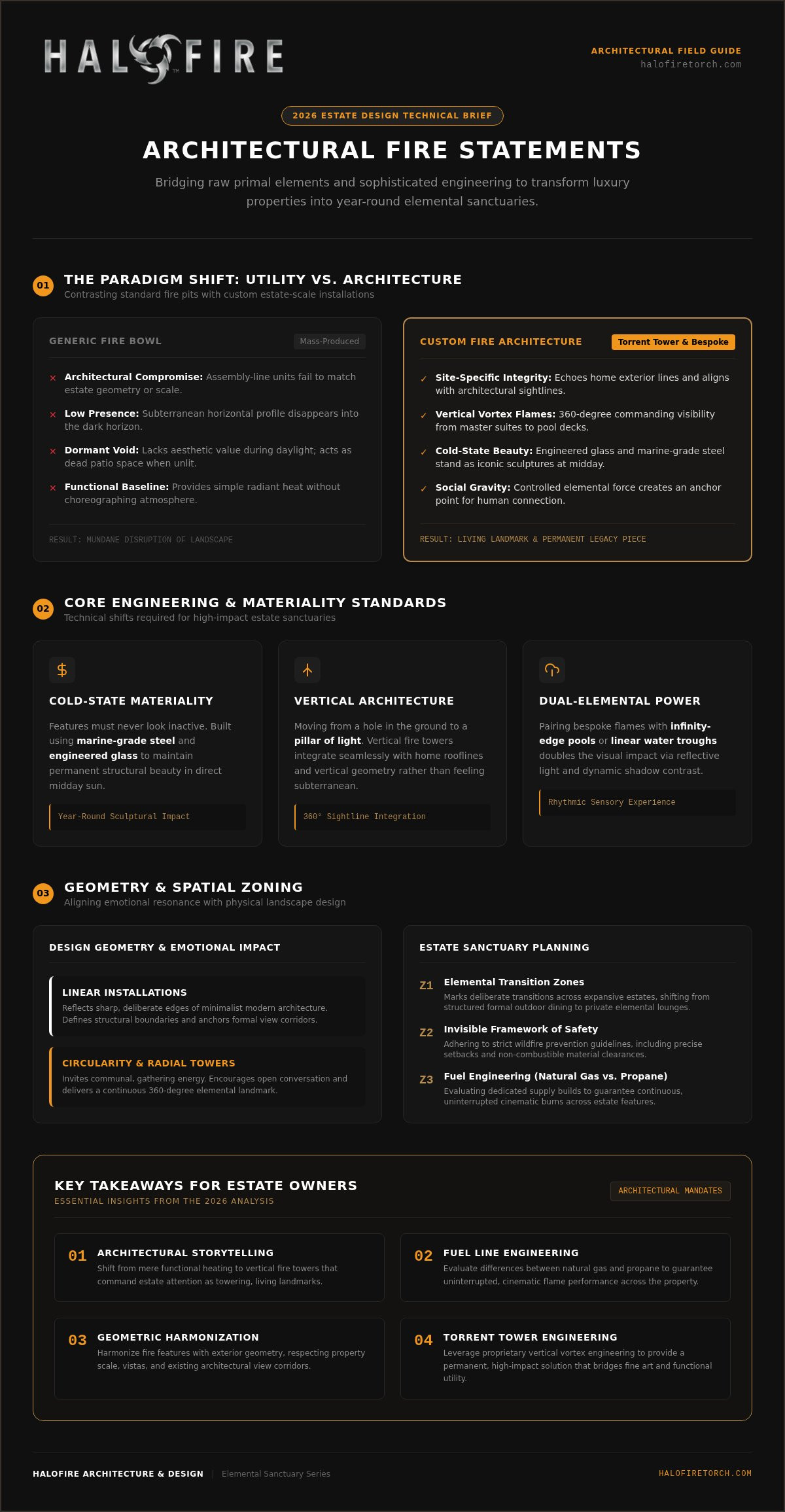
For decades, outdoor fire was largely confined to fireplaces and low-profile fire pits. Today, designers have far more options. Fire can rise vertically, mount to a wall, frame an entrance, reflect across a pool or become a custom sculptural installation designed specifically for the property.
That shift is changing the role of fire in outdoor design.
Instead of asking where to place a fire pit, homeowners, architects and designers are increasingly asking a different question:
What can fire contribute to the architecture?
At HaloFire, that's the question that drives our work.
This guide explores the evolution of custom outdoor fire features, including vertical fire, vortex flames, natural gas and propane systems, material selection, scale and the integration of fire into modern landscapes.
Key Takeaways
- Custom outdoor fire features can be designed as architectural elements rather than added as accessories after the landscape is complete.
- Vertical fire increases flame visibility while often requiring a smaller footprint than a traditional fireplace or large fire pit.
- Natural gas is particularly well suited to permanent architectural installations, while propane provides additional flexibility.
- Vortex fire uses controlled airflow to create a distinctive spinning vertical flame.
- Scale, sightlines and surrounding architecture should influence the size and placement of any fire feature.
- Custom fire design should consider gas supply, ignition, ventilation, materials and clearances early in the project.
- The strongest installations are designed around the flame rather than simply placing a burner inside a decorative enclosure.
Beyond the Standard Fire Pit
There is nothing inherently wrong with a traditional fire pit.
But it is no longer the only option.
Modern outdoor environments have evolved into extensions of the architecture. Pools, terraces, outdoor kitchens and landscape structures are increasingly designed with the same attention to proportion and materials as the interior of the home.
Fire can receive the same treatment.
A custom outdoor fire feature can respond directly to the geometry of the property rather than forcing the landscape to accommodate a predetermined product.
The dimensions can change.
The materials can change.
The orientation of the flame can change.
Even the way the flame moves can become part of the design.
Fire as an Architectural Element
Fire has one quality that almost every other architectural material lacks:
It moves.
Stone is static. Steel is static. Glass is static.
Fire changes constantly.
That movement naturally attracts the eye, particularly after dark.
Used deliberately, fire can establish a focal point, define an entrance, create symmetry or visually connect different areas of a property.
The objective isn't simply to create heat.
It's to decide what role the flame should play in the environment.
Designing for the Off State
A well-designed architectural fire feature also has to work when it isn't burning.
During the day, the structure remains visible as part of the landscape.
Its proportions, materials and finish should therefore complement the surrounding architecture even without the flame.
This is particularly important for large freestanding and custom installations.
At night, the fire becomes the focal point.
During the day, the architecture has to stand on its own.
Vertical Fire: Moving Beyond the Horizontal Flame
One of the most significant opportunities in contemporary fire design is verticality.
Traditional fire pits spread flame horizontally near ground level.
Vertical fire does the opposite.
By moving the flame upward, it becomes visible from a greater distance and can interact with the architecture in completely different ways.
A vertical fire feature can frame an entrance.
It can rise beside a pool without blocking the view.
It can mount to a wall.
It can create repetition across a landscape.
Or it can stand alone as a sculptural focal point.
Why Vertical Fire Changes the Experience
Height changes visibility.
A low fire pit can disappear behind furniture, landscaping or people seated around it.
A vertical flame remains visible.
That becomes especially important on large properties where the fire may be viewed from inside the home, across a pool or from another area of the landscape.
Vertical fire also creates a fundamentally different silhouette.
Instead of becoming part of the ground plane, the flame becomes part of the architecture.
The Torrent Tower™ and the Vortex Flame
The Torrent Tower™ represents HaloFire's approach to vertical architectural fire.
Instead of spreading fire across a conventional burner pan, the Torrent Tower presents the flame vertically within a glass structure.
Controlled airflow encourages the flame to rotate as it rises, creating the signature HaloFire vortex.
The result is constantly changing.
The flame stretches, tightens, twists and reforms.
That's the point.
The fixture provides the structure.
The flame provides the show.
Torrent Tower™ Stand Alone
The Torrent Tower™ Stand Alone brings that vertical vortex flame into a freestanding propane configuration.
At approximately 78 inches tall, it creates a substantial architectural presence while remaining independent of a permanent natural gas connection.
A standard 20 lb propane cylinder is concealed within the base, supplying the approximately 40,000 BTU/hr burner.
That makes it possible to position architectural-scale fire beside a pool, on a terrace or near an entrance without trenching a gas line to the location.
The result occupies an interesting space between fire feature and sculpture.
Designing Around the Vortex
A vortex flame depends on airflow.
The burner, air inlets, glass and surrounding structure all influence the movement of the flame.
Rather than treating airflow simply as an environmental problem, HaloFire uses it as part of the design.
The architecture of the product helps create the behavior of the fire.
That principle extends beyond the Torrent Tower.
It is fundamental to HaloFire's approach to vortex fire.
Fire and Water
Few combinations have as much visual impact as fire and water.
Position a flame near a pool and the reflection effectively extends the fire across the surface.
Vertical fire amplifies that effect because more of the flame remains visible above the waterline and surrounding furniture.
This creates several possibilities.
A pair of fire features can establish symmetry at opposite ends of a pool.
Multiple torches can create repetition along the perimeter.
A single large vertical feature can provide a dominant focal point.
The correct approach depends on the geometry and scale of the property.
The important thing is to design the fire in relation to the water rather than treating the two as separate elements.
Natural Gas vs. Propane for Custom Fire Features
Fuel selection affects both engineering and installation.
Natural gas and propane can both produce substantial architectural fire when the burner and fuel-delivery system are properly designed.
Neither fuel is universally better.
The right choice depends on the project.
Natural Gas
Natural gas is particularly well suited to permanent fire installations.
If gas infrastructure can be incorporated during construction or landscape renovation, a dedicated supply can provide convenient operation without individual cylinders.
This becomes especially useful when multiple fire features will operate simultaneously.
Gas capacity should be evaluated early.
Pipe diameter, total run length, available pressure, regulators and the demand of other appliances can all affect the amount of gas available at the fire feature.
A large burner cannot deliver its intended flame if the infrastructure feeding it cannot supply the required volume.
For custom projects, the desired flame performance and gas requirements should therefore be considered before hardscape and finishes are completed.
Propane
Propane provides another option when natural gas isn't available or when greater placement flexibility is desirable.
It can supply permanent architectural fire features from a centralized tank or power certain self-contained products from individual cylinders.
Propane contains more energy per unit volume than natural gas and is commonly supplied to appliances at a different regulated pressure.
That does not automatically produce a larger or better-looking flame.
Burner design, orifice sizing, regulator capacity, available pressure and gas volume all work together to determine performance.
The system should be engineered for the fuel being used.
Materials Matter
A custom outdoor fire feature lives in a demanding environment.
Heat is only one consideration.
Rain, humidity, UV exposure, temperature changes and—in coastal environments—salt exposure can all influence material selection.
Stainless steel, aluminum, fabricated steel, glass, concrete and masonry can each play a role depending on the application.
The correct material depends on both engineering and aesthetics.
Metal
Metal allows designers to create forms that can be difficult to achieve with conventional masonry.
Clean edges.
Thin profiles.
Tall structures.
Complex geometry.
Stainless steel provides excellent corrosion resistance and durability for many outdoor applications.
Properly selected aluminum alloys can also provide strong corrosion resistance while reducing weight.
Powder-coated fabricated metal allows additional control over color and finish.
In coastal environments, material and finish selection deserve additional consideration because salt exposure can accelerate corrosion.
There is no single material that is automatically correct for every installation.
Glass
Glass can provide visibility while also becoming part of the architecture of the flame.
In enclosed vortex features, it can help define the airflow environment while allowing the fire to remain visible from multiple directions.
Because glass near fire can become extremely hot, the type of glass, mounting system and operating clearances need to be appropriate for the specific product.
Scale: Designing Fire for the Space
One of the most common design mistakes is choosing a fire feature without considering the scale of the surrounding environment.
A feature that appears substantial by itself may disappear beside a large home or expansive pool.
The opposite is equally true.
A massive fire feature can overwhelm a small terrace.
There is no universal correct dimension or BTU output.
The appropriate scale depends on the architecture, viewing distance, intended use, desired flame presence and available gas infrastructure.
Design for the Viewing Distance
Ask where the fire will actually be seen.
Six feet away?
Across a pool?
Through the windows from inside the house?
From the opposite side of a restaurant patio?
The farther the primary viewing distance, the more important scale and flame visibility become.
This is one reason vertical fire can work so well in large outdoor environments.
It moves the flame into the sightline.
Designing in Multiples
One fire feature creates a focal point.
Multiple fire features create rhythm.
Pairs naturally establish symmetry and work particularly well around entrances, stairs and architectural openings.
Longer sequences can define walkways, pool perimeters and transitions between outdoor rooms.
But more isn't automatically better.
Spacing should allow each flame to remain visually distinct.
The goal is repetition—not clutter.
Wall-Mounted Architectural Fire
Custom outdoor fire doesn't have to occupy floor space.
Walls and columns provide another opportunity to integrate flame directly into the architecture.
The HaloFire Torrent™ Wall Mounted Torch uses this approach.
Its vertical vortex flame creates movement on an otherwise static architectural surface while preserving the surrounding floor area.
Multiple wall-mounted torches can create repetition across a long masonry wall or façade.
This is particularly effective in residential entrances, restaurants, resorts and other hospitality environments where the fire becomes part of the identity of the space.
Tall Architectural Torches
Tall gas torches offer another way to distribute fire throughout a landscape.
Products such as the Tempo™ Tall Torch and Hollywood™ Tall Torch bring the flame upward while maintaining a narrow footprint.
This allows designers to create vertical points of fire without constructing large masonry structures.
Tall torches can frame entrances, establish the boundaries of outdoor rooms or create a repeating sequence across a property.
The architecture remains open.
The fire provides the structure.
Portable Fire Within a Custom Landscape
Not every element needs to be permanent.
Portable fire can complement permanent architectural installations by allowing the environment to change.
HaloFire approaches portable fire in two different ways.
The Torrent Tower™ Stand Alone provides substantial propane-powered vortex fire without permanent gas infrastructure.
Smaller liquid-fuel products such as Helion™ provide even greater flexibility.
Helion™ Glass-Free Vortex Torch
Helion™ takes the vortex concept and removes the glass enclosure.
Its all-metal architecture controls airflow around the flame while leaving one side open, creating a visible spinning flame within a compact structure.
Helion uses compatible HaloFire liquid fuel rather than propane or natural gas.
That means there is no permanent gas line and no propane cylinder.
Place it beside the pool.
Move it to a dining area.
Use several throughout the landscape.
Portable and permanent fire don't have to compete.
They can work together.
ClearFire™ and CitroFlame™
HaloFire portable liquid-fuel products use compatible purpose-designed fuels.
ClearFire™ is formulated for a clean-burning flame and is available in HaloFire's brighter new formulation.
CitroFlame™ incorporates citronella while producing a larger visible flame for outdoor environments where insect deterrence is desirable.
These fuels are intended only for compatible HaloFire liquid-fuel products.
They should never be introduced into natural gas or propane fire features.
Planning a Custom Fire Project
The best time to think about architectural fire is before construction is complete.
Early planning gives designers and contractors the ability to coordinate gas infrastructure, electrical requirements, mounting, ventilation and clearances before hardscape and finishes make changes difficult.
Start with a few fundamental questions:
- What should the fire accomplish visually?
- Where will it be viewed from?
- Should it be permanent or portable?
- Is natural gas available?
- How much gas capacity is available?
- Is electronic ignition desirable?
- What materials surround the installation?
- What clearances does the specific fire feature require?
- How will the product be accessed for future service?
Answering those questions early can prevent expensive compromises later.
The HaloFire Approach to Custom Fire
HaloFire was built around the flame.
We don't believe fire needs to be confined to a conventional fire pit or fireplace.
It can spin.
It can rise vertically.
It can mount to a wall.
It can stand beside a pool.
It can move.
And when a project requires something entirely different, it can be designed specifically for the architecture.
Our work spans portable liquid-fuel torches, permanent natural gas and propane products, vertical vortex fire and large-scale custom installations.
Different products solve different problems.
The philosophy remains the same:
Make the flame the focal point.
Custom Architectural Fire
Some projects require something that doesn't exist yet.
HaloFire works with designers, architects, builders and property owners to develop custom fire features around the requirements of individual projects.
That can include changes in scale, geometry, mounting or flame presentation.
Custom fire requires engineering as well as design.
Fuel supply, burner configuration, airflow, ignition, heat management, clearances and serviceability all need to work together.
The goal isn't customization for its own sake.
It's creating a fire feature that feels like it was designed with the property from the beginning.
Frequently Asked Questions
How do custom outdoor fire features differ from standard fire pits?
A standard fire pit is generally designed as a finished product with predetermined dimensions, burner configuration and materials.
A custom outdoor fire feature can be developed around the architecture and requirements of a specific project.
That may involve different dimensions, mounting configurations, materials, burner geometry or flame presentation.
The primary advantage is integration.
Instead of adapting the landscape to the fire feature, the fire feature can be designed for the landscape.
What fuel is best for a custom outdoor fire feature?
There isn't one best fuel for every project.
Natural gas is particularly useful for permanent installations where adequate infrastructure is available.
Propane provides an alternative when natural gas isn't available and can also support self-contained fire features.
HaloFire liquid-fuel products use compatible fuels such as ClearFire™ and CitroFlame™ when maximum portability is desired.
The appropriate fuel depends on the product and installation.
Can a custom gas fire feature be installed on a wooden deck?
That depends on the specific fire feature, required clearances, deck construction and manufacturer's installation instructions.
Gas fire features can still produce substantial radiant and conducted heat.
Never assume a product is suitable for a combustible surface simply because it uses gas.
Follow the requirements for the individual product and applicable local codes.
How much natural gas pressure does a custom fire feature require?
Gas requirements are product-specific.
Natural gas appliances commonly operate at relatively low appliance pressures, but the required inlet pressure, gas volume and pipe sizing depend on the particular burner and installation.
For large custom installations, available gas capacity can be just as important as pressure.
Use the specifications supplied for the actual product and have the gas system sized appropriately.
Can outdoor fire features operate in rain and wind?
Outdoor fire features are designed for exterior environments, but weather can affect any open flame.
Wind direction, wind velocity, precipitation and surrounding structures can influence flame behavior.
Certain designs use glass and controlled airflow to improve flame stability, but no outdoor fire feature should be assumed to operate safely under all conditions.
Follow the operating instructions and limitations for the individual product.
Do custom fire features require special maintenance?
Maintenance depends on the particular feature and environment.
Burner openings and airflow passages should remain clear of debris.
Glass and exterior surfaces should be cleaned as appropriate for their materials.
Gas connections, ignition systems and flame-sensing components should be inspected according to the manufacturer's recommendations.
Coastal environments may require more frequent exterior cleaning because of salt exposure.
How do I choose between natural gas and propane?
Start with infrastructure and intended use.
Natural gas is often ideal for permanent installations where an adequately sized gas supply is already available or can be installed.
Propane can provide greater flexibility where natural gas isn't available and can support both permanent and self-contained applications.
Neither should be selected solely because of assumptions about flame size.
The burner and fuel-delivery system should be engineered together.
What materials are best for custom outdoor fire features?
There is no universal best material.
Stainless steel, aluminum, fabricated steel, glass, concrete, stone and masonry can all be appropriate depending on the design and environment.
Coastal exposure, heat, weight, finish, structural requirements and the desired architectural appearance should all influence the decision.
For custom work, materials should be selected as part of the overall engineering and design process.
Fire, Designed Around the Architecture
The evolution of outdoor fire isn't about making a bigger fire pit.
It's about removing the assumption that fire has to be a pit at all.
Fire can become vertical.
It can become architectural.
It can become part of the wall, the entrance, the pool or the landscape.
And when the architecture calls for something that hasn't been built before, the fire can be designed specifically for it.
Don't add fire after the design is finished. Make fire part of the design.
HaloFire — Where fire is art.

